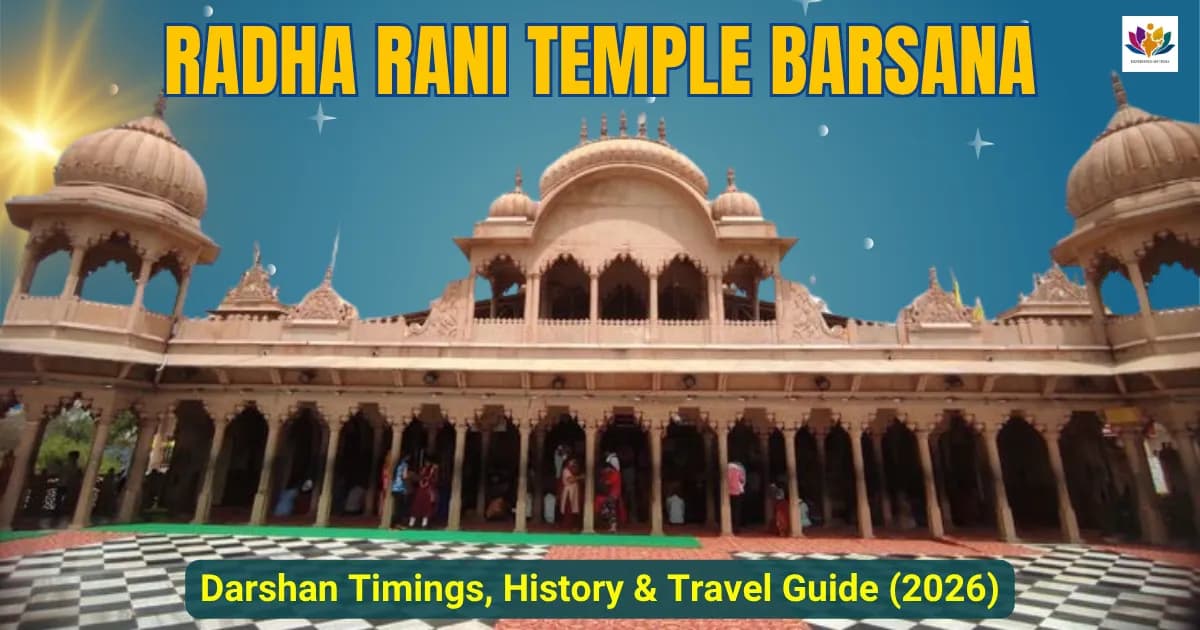
Radha Rani Temple Barsana - Darshan Timings, History & Travel Guide (2026)
By Yash Shrivastav · 12 Apr 2026
Quick Enquiry
There’s something about Barsana that feels softer than Vrindavan. Maybe it’s the hills, maybe it’s the pace, or maybe it’s the emotion attached to Radha Rani Temple Barsana, also known as Shri Ladli Ji Barsana. You don’t just arrive here and rush for darshan. Instead, you slow down… sometimes without even noticing it. And that shift in pace is exactly what makes this place feel different from most temples you’ve visited before.
Quick Info – Radha Rani Temple Barsana
Detail | Information |
Temple Name | Radha Rani Temple Barsana (Shri Ladli Ji Barsana) |
Location | Barsana Hills, Uttar Pradesh |
Entry Fee | Free |
Darshan Timings | 5:00 AM – 2:00 PM & 5:00 PM – 9:00 PM |
Famous For | Radha Rani Birthplace Temple |
Best Time to Visit | Evening Aarti & Festivals |
Distance from Mathura | 50–53 Km |
Ideal Visit Duration | 2–3 Hours |
Temple Darshan Timings – Plan Before You Climb
Timing matters more than people expect here, especially because reaching the temple involves climbing steps.
Darshan Timings Table
Season | Morning Darshan | Evening Darshan |
Summer (Apr–Sep) | 5:00 AM – 1:30 PM | 4:30 PM – 9:00 PM |
Winter (Oct–Mar) | 5:30 AM – 1:00 PM | 4:00 PM – 8:30 PM |
Now here’s something practical—morning darshan feels peaceful, but evening darshan feels more complete. The lighting, the chants, and the hilltop view combine in a way that stays with you longer.
For more details - Shri Radha Rani Temple Barsana: History, Darshan Timings, Aarti Schedule, Location, Entry and Complete Guide
Temple Aarti Timings – When the Temple Feels Alive
Aarti | Summer Timing | Winter Timing |
Mangala Aarti | 5:00 AM | 6:00 AM |
Shringar Aarti | 7:30 AM | 8:30 AM |
Rajbhog Aarti | 1:30 PM | 1:00 PM |
Sandhya Aarti | 7:30 PM | 6:00 PM |
Shayan Aarti | 8:30 PM | 8:00 PM |
If you’re visiting for the first time, try attending Sandhya Aarti. It’s not just about the ritual—the entire hill, the temple lights, and the sound of bells create a moment that feels immersive.
History of Radha Rani Temple Barsana – More Than Just a Timeline
The story of Radha Rani Temple Barsana goes beyond dates and construction. It is believed to be located at the birthplace of Radha Rani, which is why Barsana itself holds such deep emotional importance in Braj Bhoomi.
The temple, also known as Shri Ladli Ji Barsana, has been a center of devotion for centuries. While the current structure has been renovated over time, the spiritual identity of the place has remained unchanged. What’s interesting is that this temple doesn’t rely on grandeur—it relies on belief. And that belief has been strong enough to carry it through generations.
Significance – Why This Temple Feels So Personal
Unlike many temples where devotion feels collective, Radha Rani Mandir Barsana darshan often feels personal. The connection here is not just with Krishna, but with Radha as an individual presence.
Most people don’t notice this, but the energy here feels softer. It’s less about intensity and more about emotion. That’s why many visitors say they feel more connected here than in larger, more crowded temples.
The Climb – A Part of the Experience
Reaching Radha Rani Temple Barsana involves climbing around 200–250 steps. It may sound tiring, but the climb itself becomes part of the experience.
You’ll notice small shops, people resting midway, and occasional views of Barsana from above. And strangely, by the time you reach the top, you don’t feel exhausted—you feel prepared.
Festivals – When Barsana Comes Alive
If you really want to understand Barsana temple visit guide, you need to see it during festivals.
Lathmar Holi (February–March) – The most famous celebration in Barsana
Radhashtami (August–September) – Celebrating the birth of Radha Rani
Janmashtami – Also celebrated with devotion
During these times, the entire town transforms. However, crowds increase significantly, so planning becomes important.
Nearest Places to Visit – Extend Your Journey
Kirti Mandir Barsana – Around 1–1.5 Km, associated with Radha Rani’s childhood
Maan Mandir – Quiet hilltop temple with scenic views
Mor Kutir – Connected to Krishna’s playful pastimes
Rangeeli Mahal – Spiritual complex nearby
Instead of rushing through all places, it’s better to take breaks and experience Barsana slowly.
Distance & Travel Details
Place | Distance |
Mathura Railway Station | 50–53 Km |
Vrindavan | 40–45 Km |
Delhi | ~150 Km |
Crowd Behavior & Practical Observations
Crowd behavior here changes depending on time and season. Mornings are quieter, but evenings feel more alive. During festivals, movement slows down significantly, especially on the steps.
Also, footwear stands and local vendors are available, but it’s better to carry minimal belongings. Small details like these make a big difference in your experience.
Planning Support Partner
Planning a visit to Radha Rani Temple Barsana looks simple, but timing, routes, and crowd flow can change the experience completely. This is where Vrindavan Mathura Guide becomes helpful, not in a promotional way, but as a practical support system. From deciding the right darshan timing to combining nearby places efficiently, having that clarity makes your journey smoother, especially if it’s your first visit to Barsana.
How to Reach Radha Rani Temple Barsana
By Car
From Mathura → Around 1.5 hours
From Vrindavan → Around 1 hour 15 minutes
Roads are mostly smooth, last stretch includes hill climb
By Train
Nearest station: Mathura Junction
Taxi fare: ₹1500–₹2500 approx (round trip)
Shared vehicles available but less frequent
By Air
Nearest airport: Delhi Airport
Then travel by road (approx 3–4 hours total)
A Small Detail Most Visitors Miss
When you finally reach the top and look around, you’ll notice something—people don’t leave immediately after darshan. They sit, they pause, they look around. It’s subtle, but it shows how the place affects people.
Conclusion
Some places stay in memory because of what you see, while others stay because of what you feel. Radha Rani Temple Barsana quietly does the second. It doesn’t rush you, it doesn’t overwhelm you—it simply gives you space to experience something at your own pace. And maybe that’s why, even after leaving, a part of your mind stays back on that hill, without you even realizing it.
.webp&w=1920&q=75)
.webp&w=1920&q=75)