Travel Guide · Travel Guides · Updated October 2026
Vrindavan vs Dwarka: Krishna’s Two Homes Compared
By Gurudutt, Experience My India·23 October 2026
Quick Answer
Quick Enquiry
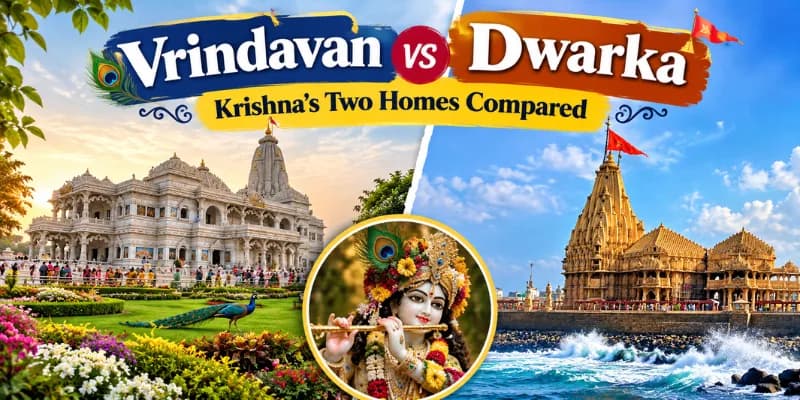
Vrindavan and Dwarka map Krishna’s journey from a playful, rural childhood to a majestic, kingly adulthood. In Vrindavan he is Balagopala, the cowherd boy of Braj, living among simple villagers, cows and the gopis, hiding his divinity to love and be loved on a human level. In Dwarka he is Dwarkadhish, the ruler and statesman who built a golden fortress on the sea to protect his people, the Lord of duty and cosmic order. Same Krishna, two worlds and two very different flavours of devotion, which is exactly what makes comparing them so illuminating. See our Mathura Vrindavan tour Packages or message WhatsApp +91 7302265809.
Core differences compared
A simple side-by-side of the two homes of Krishna, by mood, role, companions and pilgrimage status.
Feature | Vrindavan (the playground) | Dwarka (the capital) |
Geographic location | Uttar Pradesh, near Mathura | Gujarat, on the western coast |
Primary mood (rasa) | Madhurya, sweetness, intimacy, pure love | Aisvarya, majesty, opulence, royal power |
Krishna’s role | Playful cowherd boy (Balagopala, Kanhaji) | Ruler, statesman and king (Dwarkadhish) |
Divine companions | Radha, the gopis and his cowherd friends | Queen Rukmini, Satyabhama and the Yadavas |
Symbolic attire | Simple clothes, a peacock crown and a flute | Royal crown, heavy armour and weapons |
Pilgrimage status | Heart of the Braj Bhoomi circuit | One of the four sacred Char Dham sites |
The devotional atmosphere
Beyond the facts, the two places feel profoundly different to a devotee. This is the heart of the comparison.
Vrindavan: intimacy and sweet pastimes
Vrindavan is defined by intimacy and the sweet pastimes (leelas) of Krishna. It represents the pinnacle of accessible, personal love: in the streets and groves of Braj, Krishna hides his divinity to connect with his devotees on a human level, as a child, a friend, a beloved. This is the realm of madhurya-bhava, the mood of sweet, intimate love and of prema, ecstatic devotion, where the relationship with the Lord is tender and personal rather than awestruck. Devotees drawn to emotional, loving devotion feel most at home here, among the banke bihari temple, the groves of nidhivan and the land of Radha and the gopis.
Dwarka: duty, sovereignty and majesty
Dwarka is defined by duty (dharma) and sovereignty. Known as Krishna’s Karma Bhoomi, the land of his action, it is where the mature Krishna built a golden fortress city to protect his citizens from external threats and reigned as a king and statesman. Its mood is aisvarya-bhava, the devotion of majesty and reverence, where Krishna is revered as the supreme architect of cosmic order and the protector of dharma. Where Vrindavan is the heart, Dwarka appeals to those who worship Krishna as the awe-inspiring Lord of the universe. Its atmosphere is grander, more meditative and architecturally majestic.
In short: Vrindavan is a lively, colourful celebration of divine innocence and intimacy, while Dwarka carries a grander, more awe-inspiring and sovereign tone. Neither is higher; they are two moods of the same infinite Krishna.
Which should you visit?
It depends on what your heart seeks. If you long for the tender, playful, intimate Krishna, the Krishna of love, childhood and sweet pastimes, then Vrindavan and the wider Braj Bhoomi (Mathura, Govardhan, Barsana, Gokul) are your pilgrimage. If you are drawn to Krishna as the majestic king and protector of dharma, Dwarka, one of the Char Dham on the Gujarat coast, calls. They are in different states and far apart, so most pilgrims visit them on separate journeys rather than one trip and many, over a lifetime, come to cherish both moods.
If Vrindavan is calling you, it is an easy and rewarding pilgrimage: about 12 km from Mathura, with Mathura Junction the nearest major railhead, see our how to reach vrindavan guide and our best time to visit vrindavan and mathura vrindavan tour itinerary guides to plan it well.
The scriptures and legends behind each
Both homes of Krishna are rooted in the classical texts, though in different parts of the story. The pastimes of Vrindavan, by tradition, are told most fully in the tenth canto of the Srimad Bhagavatam: the butter thefts, the lifting of Govardhan hill, the raas leela with the gopis and the love of Radha and Krishna that later poets and saints made the centre of Braj devotion. These are presented as the childhood and youth lila of Krishna, the period when, it is said, he hid his divine majesty so that his devotees could love him simply and without fear.
Dwarka belongs to a later and more historical-feeling layer of the tradition. By tradition it is the kingdom Krishna established after leaving Mathura and it features prominently in the Mahabharata and the Bhagavatam as the seat of his mature life, his marriages, his role as statesman and his counsel to the Pandavas. The texts describe a magnificent island city that, after Krishna’s departure from the world, is said to have been reclaimed by the sea, a detail that gives Dwarka its particular atmosphere of grandeur touched by impermanence.
Read side by side, the two bodies of story explain why the moods differ so sharply. Vrindavan’s scriptures dwell on intimacy, play and love; Dwarka’s dwell on duty, kingship and the turning of great events. Neither account claims to cancel the other and devotees generally hold both as true chapters of one life. As with all such material, these are best received as tradition and scripture rather than as documented history and that is exactly how both pilgrimage places present themselves.
The sacred sites at each
The two destinations also differ in what you actually visit. Vrindavan is a dense town of temples and groves, old and new, where the pleasure is in moving from shrine to shrine through narrow lanes. The famous deity temples, the sweet darshan of the Thakur, the kunjs and the Yamuna ghats are all within a compact area and the wider Braj circuit, Mathura, Govardhan, Barsana, Nandgaon and Gokul, extends the pilgrimage across the whole region Krishna is said to have roamed as a boy.
Dwarka is organised around a single great temple and a scatter of associated sites along the Gujarat coast. Its focus is the towering Dwarkadhish temple, where Krishna is worshipped as king, with its tall spire and the ceremonial flag that is changed through the day. Pilgrims commonly combine it with the island of Bet Dwarka, reached by boat and with other revered sites of the Saurashtra coast, so a Dwarka pilgrimage has a more spread-out, journeying character than a day among Vrindavan’s clustered temples.
This difference shapes how a visit feels on the ground. In Vrindavan you walk, pausing at temple after temple, carried along by kirtan and crowds; in Dwarka you tend to travel between a few major points, with the sea always nearby. One is immersive and intimate in scale, the other grander and more dispersed, which matches the madhurya and aisvarya moods the two places embody. Confirm temple timings and any darshan rules locally at either destination, as these change with season and festival.
Planning a visit to each
Practically, the two are far apart and belong to separate journeys. Vrindavan sits in the Braj region of Uttar Pradesh, about 12 km from Mathura, with Mathura Junction the nearest major railhead and Delhi the nearest big airport, roughly 150 km away by the Yamuna Expressway; confirm distances and transport locally. It is one of the easiest major pilgrimages in north India to reach and pairs naturally with Agra and the rest of Braj.
Dwarka lies on the far western coast of Gujarat, usually reached via Jamnagar or Rajkot and their airports or by the rail line that runs up the Saurashtra coast; again, confirm current connections locally when you plan. Because of the distance, very few pilgrims attempt both on a single trip. Most visit Vrindavan and the Braj circuit as one pilgrimage and Dwarka, often as part of a wider Gujarat or Char Dham journey, as another.
For timing, both are most comfortable in the cooler, drier months from roughly October to March, away from the fierce heat of the north Indian and Gujarati summers; confirm seasonal conditions locally. Festival periods in each place bring the biggest crowds and the most intense atmosphere, so choose according to whether you want celebration or calm and confirm festival dates nearer the time. Whichever you are drawn to first, treat it as a complete pilgrimage in itself rather than half of a rushed pair and let the other wait for its own journey.
Let us plan your Vrindavan pilgrimage
If the sweet, intimate Krishna of Vrindavan is drawing you, we would love to help you meet him here. As Brajwasis, we can plan your whole Braj pilgrimage, Banke Bihari, Prem Mandir, Nidhivan, the ghats and out to Govardhan, Barsana and Gokul, timed around the crowds and the temple hours, with a comfortable stay and a caring guide who knows the stories behind every lane. A shared day tour starts from around 1499 rupees per person or we design a private vrindavan tour package at your pace. Darshan is free. Message us on WhatsApp at +91-7302265809 with your dates.
Related guides
Book Your Mathura - Vrindavan Trip Today
📞 +91-7302265809
💬 WhatsApp: +91-7302265809
We Reply in 30 Minutes
Packages start from ₹1,999/ person | Rated 4.5★ / 204+ Reviews
Explore all: Mathura Vrindavan Tour Packages
Jai Shri Krishna
Meet Gurudutt — Your Mathura Vrindavan Guide
Not just a tour operator — Gurudutt was born and raised in Braj Bhoomi. He has spent over a decade personally guiding pilgrims through the sacred lanes of Mathura & Vrindavan.
Founder – Experience My India
Gurudutt
Founder · Experience My India