Travel Guide · Travel Guides · Updated August 2026
Vrindavan In India , About Vrindavan Dham Town of Krishna
By Gurudutt, Experience My India·7 August 2026
Quick Answer
Quick Enquiry
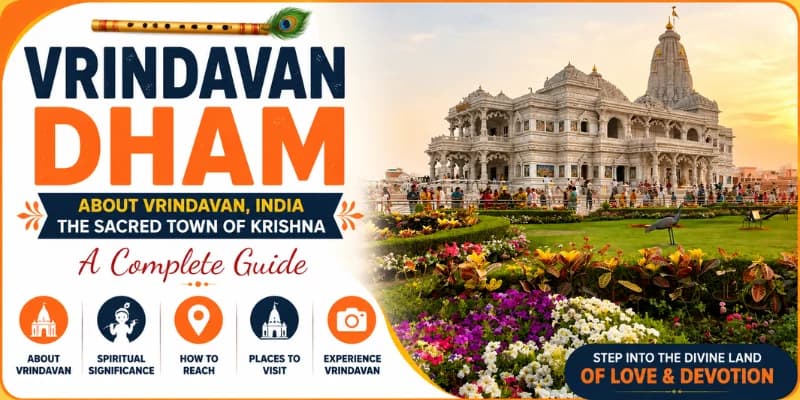
For millions of Krishna devotees, no place on earth is dearer than Vrindavan. It is not just a city on a map; it is Vrindavan Dham, the living heart of Krishna's leela, where he grew up, played and revealed himself and where the Braj tradition says his presence never left. This guide explains what and where Vrindavan is, what “dham” means here, why it is so sacred and how it fits into a Braj yatra. I am Gurudutt, born in Braj Bhoomi and Vrindavan is the land I have guided pilgrims through since 2018. See our Mathura Vrindavan tour Package or message WhatsApp +91 7302265809.
Where is Vrindavan and which state is it in?
Vrindavan is in Uttar Pradesh, in the Mathura district, on the west bank of the Yamuna about 13 km north of Mathura city. It sits in the Braj Bhoomi region of northern India, roughly 150 km south of Delhi and 55 km from Agra. Vrindavan is a small municipal town governed today as part of the Mathura-Vrindavan Municipal Corporation, with a population of about 63,005 at the 2011 census, a PIN code of 281121 and Braj Bhasha as its native tongue alongside Hindi. Though compact, it is one of the most visited pilgrimage towns in the country.
हिंदी में: वृंदावन उत्तर प्रदेश के मथुरा जिले में यमुना किनारे बसा एक पवित्र नगर है, जो मथुरा से लगभग 13 किलोमीटर दूर है। इसे वृंदावन धाम कहा जाता है, जहाँ भगवान कृष्ण ने अपना बचपन बिताया। यहाँ राधा-कृष्ण के लगभग 5,500 मंदिर हैं।
Planning your first darshan of Vrindavan Dham? Message Experience My India on WhatsApp at +91 7302265809 and we will build your Braj yatra around the temple hours.
Is Vrindavan in Mathura?
Vrindavan and Mathura are two separate towns about 13 km apart, both within the Mathura district of Uttar Pradesh. Mathura is the birthplace of Krishna and the larger city; Vrindavan is the town of his childhood leela. They are the twin sacred cities of Braj and are almost always visited together on one yatra, which is why people often speak of “Mathura Vrindavan” in a single breath, but they are distinct places with their own temples and character.
What is Vrindavan Dham and why is it sacred?
Vrindavan Dham means Vrindavan as a holy abode, not merely a town but a sacred realm where the divine is understood to be eternally present. In the Vaishnava tradition Vrindavan is revered as the earthly form of Goloka Vrindavan, Krishna's supreme abode, so devotees hold that the whole land, its groves, its dust and its river, is spiritually alive. It is the innermost part of Braj, the wider 84-kos land of Krishna's pastimes that also holds Mathura, Gokul, Govardhan, Barsana and Nandgaon. The name itself carries the meaning: Vrindavan comes from Vrinda, the sacred tulsi and van, a grove, recalling the tulsi groves of Nidhivan and Seva Kunj where the Ras Leela is said to unfold. To call it a dham is to say that in Vrindavan, devotion is not only remembered but lived.
Why is Vrindavan famous?
Vrindavan is famous as the town where Krishna spent his childhood and youth and as one of the greatest centres of Krishna and Radha worship in the world. Its fame rests on three things: its extraordinary density of temples, roughly 5,500 of them, from the ancient Radha Raman and Madan Mohan to the modern marble grandeur of Prem Mandir; its living festivals, above all the Braj Holi and Janmashtami that draw pilgrims from across the globe; and its atmosphere of unbroken devotion, the constant sound of “Radhe Radhe” in the lanes. For a devotee, Vrindavan is where the stories of Krishna stop being history and become a place you can walk through.
The famous temples of Vrindavan
Vrindavan's temples are its soul and while they number in the thousands, a handful define most yatras. The table below is a quick orientation; each links to its own full guide with darshan timings.
Temple | Known for |
The most beloved temple in Vrindavan, a self-manifested Krishna deity | |
A vast white-marble Radha Krishna temple with an evening light show | |
The globally known temple in Raman Reti, with dawn kirtan | |
One of the oldest, from 1542, with a self-manifested deity | |
A modern shrine bringing the four dhams under one roof | |
The sacred grove where devotees believe the Ras Leela unfolds nightly |
For the full list of shrines see our Famous Temples of Mathura and Vrindavan hub and for every temple's season-by-season hours in one place, the Mathura and Vrindavan temple timings guide.
Festivals of Vrindavan Dham
Vrindavan lives by its festivals and the two greatest are Holi and Janmashtami. The Braj Holi, spread across the days around the main festival in February or March, is unlike Holi anywhere else, with the flower Holi at Banke Bihari and the famous Lathmar Holi in nearby Barsana and Nandgaon. Janmashtami in August or September, Krishna's birth, fills the whole of Braj through the midnight hour. Radhashtami, Radha's appearance day about a fortnight after Janmashtami, is celebrated with special devotion here because Vrindavan is above all Radha's town. Come at a festival for the spectacle, but expect the town at its most crowded.
Best time to visit and how to reach Vrindavan
The best time to visit Vrindavan Dham is October to March, when the weather is cool for walking the temple lanes and the ghats. Vrindavan is reached through Mathura: Mathura Junction, about 14 km away, is the nearest major railway station, with fast trains from Delhi, Agra and Jaipur and the temples are a short drive on from there. By air, Delhi International Airport is the main gateway about 150 km away on the Yamuna Expressway and Agra is the nearest domestic airport at about 55 km. Most road arrivals enter near Chhatikara on the highway, close to ISKCON and Prem Mandir. For a planned visit that covers the town in the right order, see our Vrindavan and Mathura itinerary and our Mathura Vrindavan tour packages.
Where to stay in Vrindavan
Because Vrindavan is a pilgrimage town, most visitors stay in dharamshalas and ashrams near the main temples, with hotels and guesthouses clustered around Banke Bihari, Prem Mandir and the Raman Reti area near ISKCON. For an honest, on-the-ground list with price ranges, see our Vrindavan dharamshala list. Book well ahead for Holi and Janmashtami, when the whole town fills.
Ground truth: how to feel Vrindavan, not just see it
Here is what I tell every pilgrim who comes to Vrindavan Dham for the first time. Do not treat it as a checklist of temples. Walk the old lanes slowly, sit for a while at Keshi Ghat as the evening aarti begins and let the constant “Radhe Radhe” settle into you. Do your darshan in the cool morning before the temples close for their midday break, keep your phone pocketed inside Banke Bihari where photography is not allowed and give the hot afternoon to rest. If you can, come on an ordinary winter weekday rather than at a festival and the town will show you the stillness the scriptures promise. Vrindavan is not a place you finish seeing; it is a place you begin to feel.
Ready to walk Vrindavan Dham with a Braj-born guide? Experience My India has guided 50,000+ pilgrims since 2018 with a 4.5 star rating from 204+ reviews. Message +91 7302265809 on WhatsApp, call +91 7302265809 or see our Mathura Vrindavan tour packages.
A short history of Vrindavan
Vrindavan is an ancient place, revered in tradition since the age of Krishna, held to be some five thousand years ago and mentioned across the Vaishnava scriptures. As a lived city, though, much of what we see today springs from the sixteenth century onward.
The turning point was the coming of Chaitanya Mahaprabhu, the great Bengali saint, who by tradition rediscovered the lost sacred sites of Vrindavan around 1515, reviving it as a centre of Krishna devotion. His followers, the Six Goswamis of Vrindavan, settled here and established the great temples and the theology of Gaudiya Vaishnavism, uncovering and worshipping the deities and the leela-sites. Rulers such as Raja Man Singh of Amber, who built the Govind Dev temple in 1590 and later patrons endowed the city's temples.
From those foundations Vrindavan grew over the following centuries into the dense city of temples it is today, its ancient groves gradually giving way, especially over the last couple of hundred years, to lanes, ashrams and, more recently, wider urban growth. Through all of it, its identity as the city of Krishna's love has remained its whole reason for being. We attribute the ancient tradition to belief and the temple history to record.
Vrindavan today: the living city
Vrindavan today is a living, breathing pilgrimage city, not a museum. Its lanes throng with pilgrims, sadhus, cows, cycle-rickshaws and the calls of vendors; its ashrams and bhajan halls resound with kirtan; and its markets sell everything from deity clothes and prayer beads to the famous Braj sweets. It is intense, crowded and utterly alive and that intensity is part of its character.
Vrindavan is also, poignantly, sometimes called the city of widows, because for generations many widows, especially from Bengal, have come here to live out their lives in devotion in its bhajan ashrams, a social reality that has in recent years drawn charitable and government support to care for them with dignity. And like many Indian towns, Vrindavan wrestles with rapid growth, traffic and the pressure of its own popularity on its old lanes and groves. We mention these honestly and with respect, because an understanding of Vrindavan should include its present, not only its past.
The name Vrindavan: the forest of Tulsi
The name Vrindavan is beautifully simple in origin: it comes from vrinda, meaning the holy basil, or tulsi and van, meaning a grove or forest, so Vrindavan is the forest of tulsi. The tulsi plant is sacred to Krishna, its leaves offered in his worship and the town was by tradition once a grove of it. Two of those ancient groves, Nidhivan and Seva Kunj, are still revered in the heart of the city today.
In another cherished reading, the name honours Vrinda Devi, a form of the sacred tulsi and a beloved presence in the Krishna tradition, so that Vrindavan is her forest. Either way, the name carries the memory of a green, sacred grove, which is what Vrindavan was before the centuries of temple-building and, latterly, urban growth. We share these meanings as they are held within the tradition.
How far is Vrindavan from Mathura?
Vrindavan is about 13 km from Mathura city, a short drive of around 30 to 45 minutes by road, connected by the direct Mathura-Vrindavan road and the NH-2 highway with the Chhatikara approach. The two are so close that the built-up area increasingly joins them and they function as one twin-city region. A heritage rail line also runs between them.
So although Vrindavan is a separate town, it is very close to Mathura city, easily reached in half an hour or so, which is why the two are always visited together as a pair. You can base yourself in either and day-trip to the other. Our vrindavan to mathura distance guide covers the journey between them, the routes and the transport, in full. This closeness is central to why Vrindavan is thought of as being in Mathura.
Vrindavan and Mathura district
To understand how Vrindavan is in Mathura, it helps to know that Mathura is both a city and a district. Mathura district is an administrative division of Uttar Pradesh and it contains not only Mathura city but the whole of the Braj heartland, including Vrindavan, Govardhan, Barsana, Nandgaon, Gokul and Mahavan. So Vrindavan is one of the towns within Mathura district, along with these other sacred places, all under the district named after its principal city, Mathura.
This is why Vrindavan's address places it in Mathura district, Uttar Pradesh and why it is correct to say Vrindavan is in Mathura, meaning the district. The twin cities are even governed together as one municipal corporation. But within the district, Vrindavan and Mathura city are two distinct towns, each with its own identity, 13 km apart. So the district is Mathura; the two chief towns within it are Mathura city and Vrindavan.
Vrindavan: the town within Mathura
Vrindavan, the town of Krishna's childhood within Mathura district, is a city of temples, said to number in the thousands and a place of intense devotion. Its highlights include the beloved Banke Bihari temple, in the old-town lanes; the great modern temples of ISKCON and Prem Mandir on the outskirts; the ancient Goswami temples; the mysterious grove of Nidhivan; and the Yamuna ghats, chief among them Keshi Ghat, for the evening aarti. It is famed for celebrating Holi and Janmashtami with extraordinary fervour.
So while Mathura draws pilgrims to the Krishna Janmabhoomi and its old city, Vrindavan draws them to Banke Bihari and its temple lanes, the two together forming the fullest pilgrimage to the land of Krishna. Our guides to Vrindavan cover its temples, ghats, food and festivals in full. Being within Mathura district and only 13 km from Mathura city, Vrindavan is easily added to any Mathura visit and vice versa, for the complete twin-city experience.
Meet Gurudutt — Your Mathura Vrindavan Guide
Not just a tour operator — Gurudutt was born and raised in Braj Bhoomi. He has spent over a decade personally guiding pilgrims through the sacred lanes of Mathura & Vrindavan.
Founder – Experience My India
Gurudutt
Founder · Experience My India